
MusicMaster

| Fender Musicmaster | |
|---|---|
| Manufacturer | Fender |
| Period | 1956–1982 |
| Construction | |
| Body type | Solid |
| Neck joint | Bolt-on |
| Scale | 24 or 22.5 in (610 or 572 mm) |
| Woods | |
| Body | Usually Poplar Alder Ash |
| Neck | Maple |
| Fretboard | Usually Maple Rosewood |
| Hardware | |
| Bridge | Fixed |
| Pickup(s) | 1 proprietary single coil, offset variant |
| Colors available | |
| Desert Sand, Shaded Sunburst, Red-Mahogany, Olympic White, Daphne Blue, Dakota Red | |
The Fender Musicmaster was the first of their 3/4 scale guitars. With a single pickup and no vibrato system, it was a basic but functional instrument. Officially introduced in 1956, The Musicmaster was re-designed to match the newly introduced Mustang in 1964, and dubbed 'Musicmaster II' for the remainder of the 1960's. The Musicmaster was Fender's least expensive bass model (in 1973, it had a list price of $139.50, compared to $293.50 for the Precision), and with the shorter 30' was scale perfect for student musicians. It was an easy-playing good quality, solid, reliable bass. Meta data can be updated on both the MusicMaster side as well as the NextKast Side. Need to correct meta data on playout, simply correct the issue in Nextkast and changes will be sent to Music Master. Tracks can Also be moved from Category to Category from the NextKast Side and Updated to MusicMaster automatically. This 1973 Fender Musicmaster® bass has been knocked around for almost 40 years. It looks good in this photo, but up close you can see that it's been through a lot. Lots of parts replacements, a few different refin jobs (once it was actually given a stucco finish!), and who-knows-what. Photoshop for mac os free. It's kind of a beater, but it's held up great. MusicMaster is the world's most flexible and intuitive music scheduling system, used by broadcasters of all kinds to create the most competitive mix of entertainment.
The Fender Musicmaster is a solid bodyelectric guitar produced by Fender. It was the first 3/4 scale student-model guitar Fender produced.A Musicmaster Bass model was also put on the market. Musicians such as David Byrne and Liz Phair used a Fender Musicmaster.
History[edit]
1955–1963[edit]
Design work on the Musicmaster-and its two-pickup variant Duo-Sonic-began in late 1955 following a request from Fender Sales. Prototypes were made in early 1956, followed by sales literature announcing both models. Production of the Musicmaster began in late April of that year, using a body routed for two pickups to be common to the Duo-Sonic, which followed a little more than two months later. Asus driver for mac os x. The Duo-Sonic and Musicmaster also shared a single-piece maple neck and fingerboard, with a 22.5 inch scale length and 21 frets.
There was one major redesign of these two Musicmaster-bodied guitars, in 1959 when the entire Fender catalog was updated. At this time, the Musicmaster and Duo-Sonic both received a plastic pickguard in place of the previous anodized aluminum one, and a two-piece maple neck with a rosewood fingerboard.
1964–1982[edit]

In 1964, following the release of the Fender Mustang, both the Musicmaster and Duo-Sonic were redesigned using Mustang neck and body blanks. The Mustang body was larger and slightly offset, and was fitted with a plastic pickguard but with the volume and tone controls mounted on a separate metal plate. The headstock was also enlarged. All three models were offered with the option of a 24-inch scale and 22-fret neck or a 22.5-inch scale and 21-fret neck; all three models were also offered with the choice of 'round-lam,' or veneered, rosewood or maple fingerboard. The 24 inch scale proved to be the most popular of these options. The redesigned Musicmaster was named the Musicmaster II and its stablemate the Duo-Sonic II, both using the Bronco body and pickguard shapes, although decals with and without the II designation were used without any real meaning.
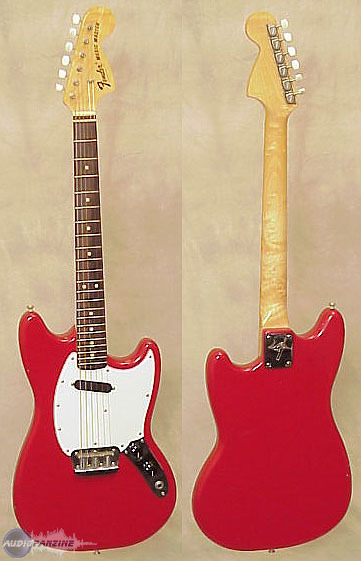
Certain models of the Musicmaster, especially from between 1978 and 1980, were finished with a coat that reacted negatively with the base coat. This causes many modern surviving Musicmasters from this period to suffer from paint flaking off the body.
The Musicmaster was produced until 1982 when both it and the Mustang were dropped in favor of the newer Fender Lead models.
The Fender Swinger, another 22.5 inch scale guitar, was produced using the Musicmaster bridge, electrics and scratchplate but with a modified Fender Bass V body.
In 2020, Fender released a special version of the Musicmaster for the Shawn Mendes Music Foundation. It features 2 pickups, a single coil and a humbucker, and is the same as the 2020 Duo-Sonic other than the pickup configuration. Unlike the Duo Sonic, the neck pickup is a humbucker and the single coil is the bridge pickup.
See also[edit]
References[edit]
- 'Fender's 3/4 Scale Guitars', a two-part article by Tim Pershing in 20th Century Guitar, December 1996 and January 1997.
- 'Little Brothers Turn 50', an article by Terry Foster and Tim Pershing in Vintage Guitar, July 2006.
- Fender: The Golden Age, 1946–1970, a book by Martin Kelly, Terry Foster, Paul Kelly. London & New York: Cassell ISBN1-84403-666-9
Musicmaster Bass

External links[edit]
Musicmaster Bass
| Wikimedia Commons has media related to Fender Musicmaster. |